Executive Summary
This report constitutes a comprehensive forensic audit of Great British Energy (GB Energy), the flagship industrial policy initiative of the UK Labour Government. Commissioned to determine the veracity of political claims regarding its benefits to Scotland, this document scrutinizes the institution’s origins, its operational reality as of early 2026, and the stark divergence between pre-election rhetoric and post-implementation outcomes.
The analysis is driven by a fundamental inquiry: Was GB Energy a genuine attempt to reindustrialize Scotland’s energy sector through public ownership, or was it a political "sop"—a symbolic concession designed to quell independence sentiment without transferring substantive economic power?
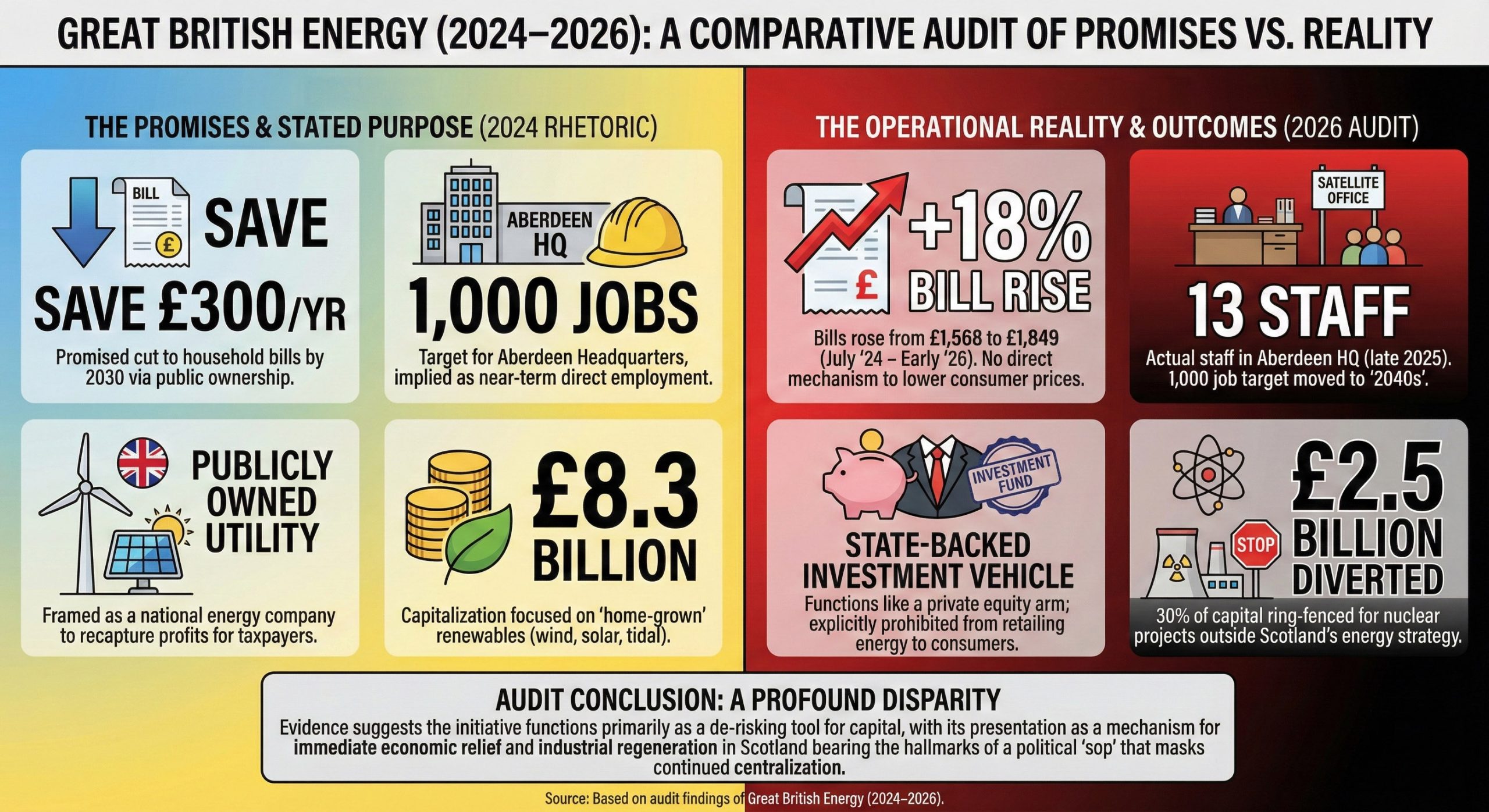
The findings are unequivocal. There exists a profound disparity between the "social contract" offered to the Scottish electorate and the delivered reality. While branded as a "publicly owned energy company," GB Energy functions primarily as a state-backed investment vehicle. It does not sell energy to consumers and possesses no mechanism to directly lower household bills [1]. Furthermore, a substantial portion of its capitalization (£2.5 billion) has been diverted toward nuclear projects [2].
As of early 2026, the promised "Headquarters" in Aberdeen employs fewer than 20 staff members, while the majority of the workforce operates from England [3]. Energy bills have risen by 18% since the government took office [4], and the Chairman of GB Energy has admitted that the target of 1,000 jobs represents a long-term aspiration that may take two decades to materialize [5].
Part I: The Genesis and Strategic Purpose
1.1 The Political Context
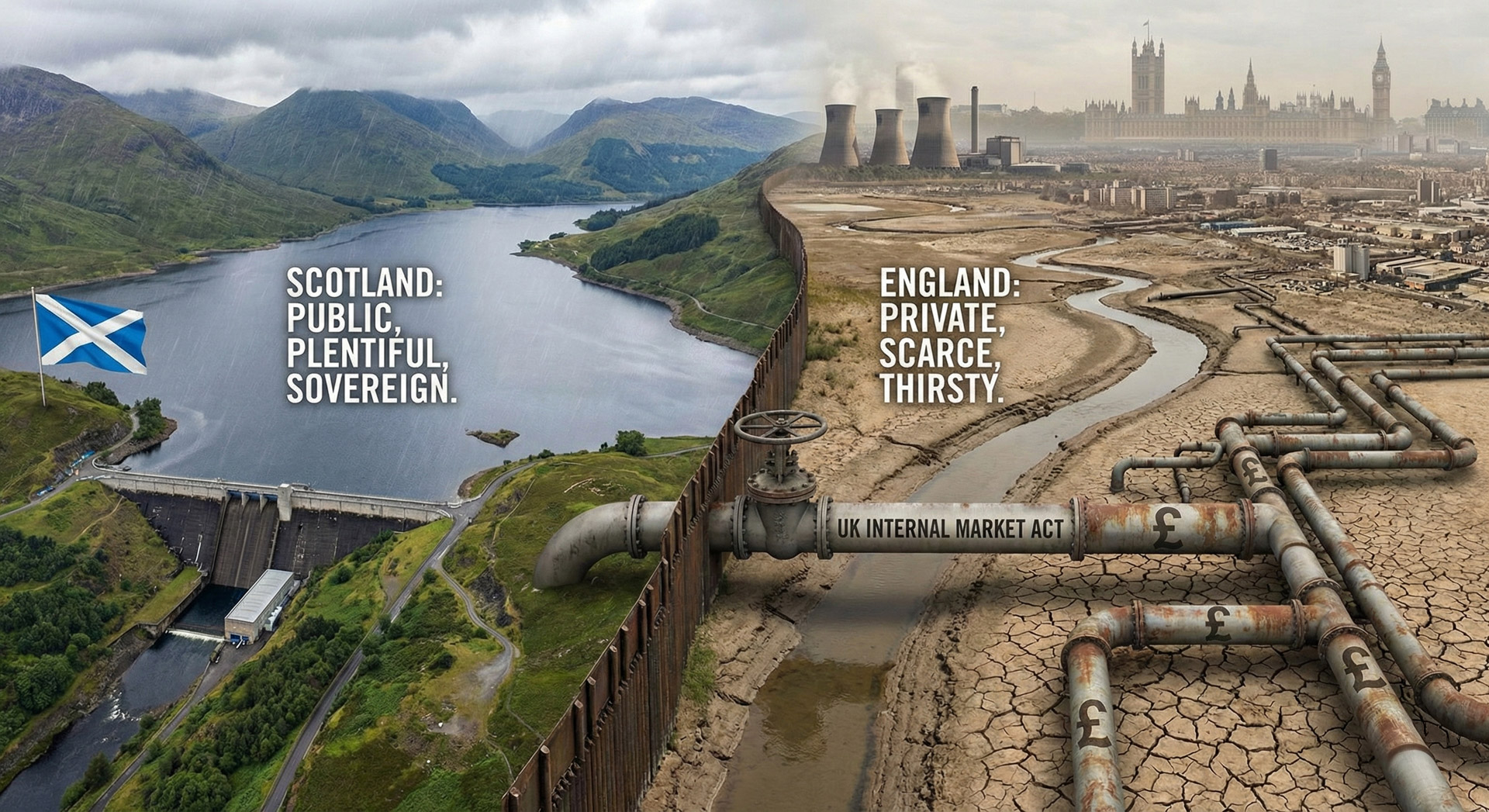
The concept of "Great British Energy" was designed as a response to the energy price crisis of 2021–2023. It was framed not merely as a policy, but as a "patriotic mission" to "make Britain a clean energy superpower" [6]. The branding was a strategic attempt to re-nationalize the concept of Scottish energy, transforming it from a Scottish asset into a "British" success story.
1.2 The Stated Purpose and "The Promise"
During the 2024 General Election campaign, the proposition of GB Energy was distilled into core promises forming a "social contract" with the electorate:
- Lower Bills: Labour leadership pledged that GB Energy would cut household energy bills by £300 per year by 2030 [7].
- Public Ownership: The manifesto promised "Energy powered by purpose, owned by the people" [8].
- Jobs for Scotland: Specifically for Aberdeen, the political messaging promised a headquarters that would be a hub of activity, creating 1,000 jobs [5].
1.3 The Legislative Vehicle
The Great British Energy Act 2025 established GB Energy as an operationally independent company owned by the Secretary of State [1]. It was capitalized with £8.3 billion over the course of the Parliament [2].
Part II: Structural Reality – Investment Vehicle vs. Energy Company
2.1 The "Retailer" Myth
Contrary to the impression given to voters, the Great British Energy Act and subsequent briefings clarify that GB Energy "will not be an energy retailer selling energy directly to consumers" [1]. It is explicitly prohibited from entering the retail market, meaning it has no mechanism to directly lower the unit price of energy for households [9].
Instead, it functions as a state-backed investment fund, co-investing in projects to "de-risk" them for private capital [10].
2.2 The Financial "Raid": Nuclear vs. Renewables
By late 2025, forensic analysis revealed a significant diversion of funds. Approximately £2.5 billion (30% of the budget) was ring-fenced for nuclear projects, specifically Small Modular Reactors (SMRs) [2]. This funding is managed by "Great British Energy – Nuclear" [11].
For Scotland, this is contentious. As the Scottish Government opposes new nuclear builds using current technology, 30% of the funding of "GB Energy" is effectively barred from being spent in Scotland, despite the headquarters being located there.
Part III: The "Aberdeen HQ" – Anatomy of a Broken Promise
3.1 The "1,000 Jobs" Pledge vs. Reality
The promise of 1,000 jobs in Aberdeen has faced severe scrutiny.
- Current Headcount: As of late 2025, GB Energy employed fewer than 70 people total, with only 13 based in the Aberdeen "Headquarters" [3].
- English Dominance: The majority of staff (42 out of 58 in one count) are based in England [3].
- Timeline Shift: Chairman Juergen Maier admitted in an interview that the 1,000 jobs target could take "up to 20 years" to achieve [5].
| Metric | Promise (Campaign 2024) | Reality (Status 2026) |
|---|---|---|
| Location | "Headquartered in Aberdeen" | Chair in Manchester, Strategy in London, 13 staff in Aberdeen [3] |
| Direct Jobs | "1,000 jobs" (implied near-term) | 13 current; 1,000 target moved to "2040s" [5] |
| Function | "Energy Company" | Investment Fund / Bureaucracy [1] |
3.2 Leadership Absenteeism
The "branch office" accusation is reinforced by the location of the leadership. The Chair, Juergen Maier, is based in Manchester, and only one board member is based in Scotland [3].
Part IV: The "Con" – Financial Analysis of the "Sop"
4.1 The "Nuclear Surcharge" on Scottish Resources
GB Energy is funded by a windfall tax on oil and gas companies—revenue largely derived from Scottish waters. Yet, £2.5bn of this is diverted to nuclear projects in England and Wales (e.g., Wylfa) [12]. This represents a transfer of fiscal capacity from Scottish resources to English nuclear infrastructure.
4.2 The Local Power Plan: Crumbs from the Table?
In early 2026, a funding round for Scottish community projects was announced. The total was £1.8 million shared among 23 projects [13]. In the context of an £8.3 billion company, this £1.8 million represents approximately 0.02% of the capital.
4.3 The Energy Bill Reality Check (2026)
The promise to cut bills by £300 has failed. In early 2026, the energy price cap rose to £1,849—an 18% increase from the level when Labour took office [4].
Part V: Detailed Evidence Audit
Conclusion
Based on the cumulative evidence, the characterization of Great British Energy as a "sop" to Scotland appears substantiated. The decision to place the HQ in Aberdeen was political, while the operational reality—13 staff members and a London-based strategy—renders it symbolic.
Furthermore, the financial flows suggest a "con" element: Scottish offshore assets are taxed to capitalize a fund where a massive tranche (£2.5bn) is immediately ring-fenced for nuclear projects in England/Wales, while Scottish community projects receive tokenistic grants. GB Energy has failed to create the promised jobs in Aberdeen or lower bills, functioning less as a tool for Scottish regeneration and more as a mechanism for maintaining centralized UK control.
References & Source Links
- House of Commons Library: Great British Energy Bill Briefing
- Institute for Government: Public Bodies Tracker - GB Energy Funding
- Believe in Scotland: GB Energy's Broken Promises
- The National: Why Are Energy Bills Rising? (RGU Energy Transition Institute)
- Energy Voice: GB Energy 1,000 jobs pledge to take two decades
- GOV.UK: Great British Energy Bill Factsheet
- Full Fact: Labour's £300 energy bill saving claim
- Labour Party Manifesto 2024: Clean Energy Superpower
- Please Connect Me: What does GB Energy mean for customers?
- Great British Energy: Strategic Plan 2025
- GOV.UK: Advanced Nuclear Technologies & GBE-Nuclear
- GOV.UK: North Wales to pioneer UK's first SMRs
- Gov.Scot: Community energy projects to benefit from £1.8 million