The governance of water resources represents one of the most profound divergences in public policy between Scotland and England since the devolution settlement. It serves as a stark illustration of two competing ideological frameworks: the Anglo-Welsh model of privatization, financialization, and market-based regulation, versus the Scottish model of public ownership, social value, and hydropolitical sovereignty. As the climate crisis accelerates and the United Kingdom faces increasingly volatile weather patterns, the strategic value of Scotland’s water resources—often termed "blue gold"—has moved from a matter of utility management to a central pillar of the constitutional debate regarding independence.
This report provides a deep-dive analysis of the water situation in both nations, examining financial structures, operational realities, cross-border connections, and the looming constitutional threats that could disadvantage Scotland under the current Union.
1. The Great Divergence: Historical Context and Structural Frameworks
The modern disparity between Scottish and English water governance is rooted in the political economy of the late 20th century. In 1989, the Conservative government enacted the Water Act, which privatized the ten regional water authorities of England and Wales.[1] This radical shift transferred the ownership of critical natural monopolies to private limited companies (PLCs) such as Thames Water and Anglian Water, driven by the belief that private capital markets would deliver investment efficiency.[2]
Scotland resisted this trajectory. A combination of intense public opposition and distinct legal traditions kept Scottish water in public hands. The Water Industry (Scotland) Act 2002 consolidated regional authorities into a single national public corporation: Scottish Water.[3] This entity is accountable to Scottish Ministers and the Scottish Parliament, ensuring that its strategic direction aligns with national priorities rather than shareholder returns.[4]
2. Financial Architectures: The Sovereignty Dividend
The most quantifiable argument for the merit of the Scottish public model lies in the financial data. The cost of financing water infrastructure—paying interest on debt and dividends to equity holders—diverges sharply between the two systems.[5]
| Financial Metric (Recent Data) | Scottish Water (Public) | English Water Companies (Private Average) |
|---|---|---|
| Financing Costs (% of Revenue) | 8% | 35% |
| Annual Investment per Household | £180 | £120 |
| Dividend Payments (Cumulative since 1989) | £0 | £85.2 Billion |
| Industry Debt | Managed Public Debt | £72 Billion |
| Average Projected Bill (2025-26) | £490 | £603 |
Research indicates that for every £100 an English customer pays in their water bill, roughly £35 is siphoned off to service the capital structure—paying bondholders and shareholders—rather than being spent on infrastructure.[5] In contrast, Scottish Water’s financing costs represented only 8% of revenue.[5]
This efficiency means that despite lower average bills, Scotland is able to invest significantly more in its infrastructure. Scottish Water invests approximately £180 per household per year, compared to an average of just £120 in England and Wales—a 50% difference in direct investment value.[5] Consequently, average annual bills for 2025-26 in Scotland are projected to be £113 cheaper than in England and Wales.[6]
3. Operational Reality: Performance and Environment
Operational data reveals that the integrated public model is out-performing its privatized counterparts. The 2025 UK Water Company Performance Survey, conducted by British Water, ranked Scottish Water as the top-performing utility in the UK, leading the sector in areas such as professionalism and innovation with a score of 7.5/10 against an industry average of 6.3.[7]
Environmental health also shows a marked divergence. Data shows that 66% of Scotland’s water bodies are classified as having "good" ecological status, compared to just 16.1% in England.[8] While critics often cite differences in monitoring density regarding sewage spills, independent fact-checkers have found claims that Scotland's pollution is worse than England's to be "mostly false" when looking at the overall ecological health.[1] Furthermore, Scottish Water has committed to a £500 million program to install monitors on all combined sewer overflows (CSOs) by the end of 2024 to close any data gap.[9]
4. England’s Looming Crisis: The Thirst of the South
To understand the future risks to Scotland, it is vital to understand the scale of the crisis facing England. The Environment Agency’s National Framework presents a dire outlook for England’s water security. By 2055, England faces a projected shortfall in public water supply of nearly 5 billion litres per day if no action is taken.[10]
When additional needs for energy production, agriculture, and environmental protection are included, the total deficit rises to roughly 6 billion litres per day—equivalent to a third of current daily supply.[11] While England’s current plans involve 10 new reservoirs and major internal transfers (such as the Grand Union Canal Transfer scheme), the sheer scale of this "water stress" ensures that the strategic gaze will inevitably turn North.[12] [13]
5. Cross-Border Dynamics and Plans for a "Super Canal"
Currently, physical connections are limited to shared river basins and historical industrial infrastructure.
- Solway Tweed: The primary shared resource is the Solway Tweed River Basin District, managed jointly by SEPA and the Environment Agency. This is a co-management framework for ecological health, not a bulk export mechanism.[14]
- Kielder Water: The UK’s largest reservoir sits in Northumberland, just south of the border. It was historically considered as a cooling source for the Chapelcross nuclear site in Scotland.[15] It remains a logical staging post for any future North-South transfer schemes.
However, the concept of a "National Water Grid" to pipe large amounts of water from Scotland to England has existed for decades. In 2022, reports confirmed that senior Conservatives were exploring plans for a £14 billion "super canal" to move water from Scotland and Wales to the drought-hit South East of England.[16]
The Scottish Government has stated in Freedom of Information responses that there are currently no plans to export water, arguing that bulk transfers via pipeline or shipping remain economically unviable compared to alternatives like desalination.[17] However, as England's deficit grows, the economic viability calculation may change, increasing political pressure on Scotland.
6. Constitutional Vulnerability: The Internal Market Act Threat
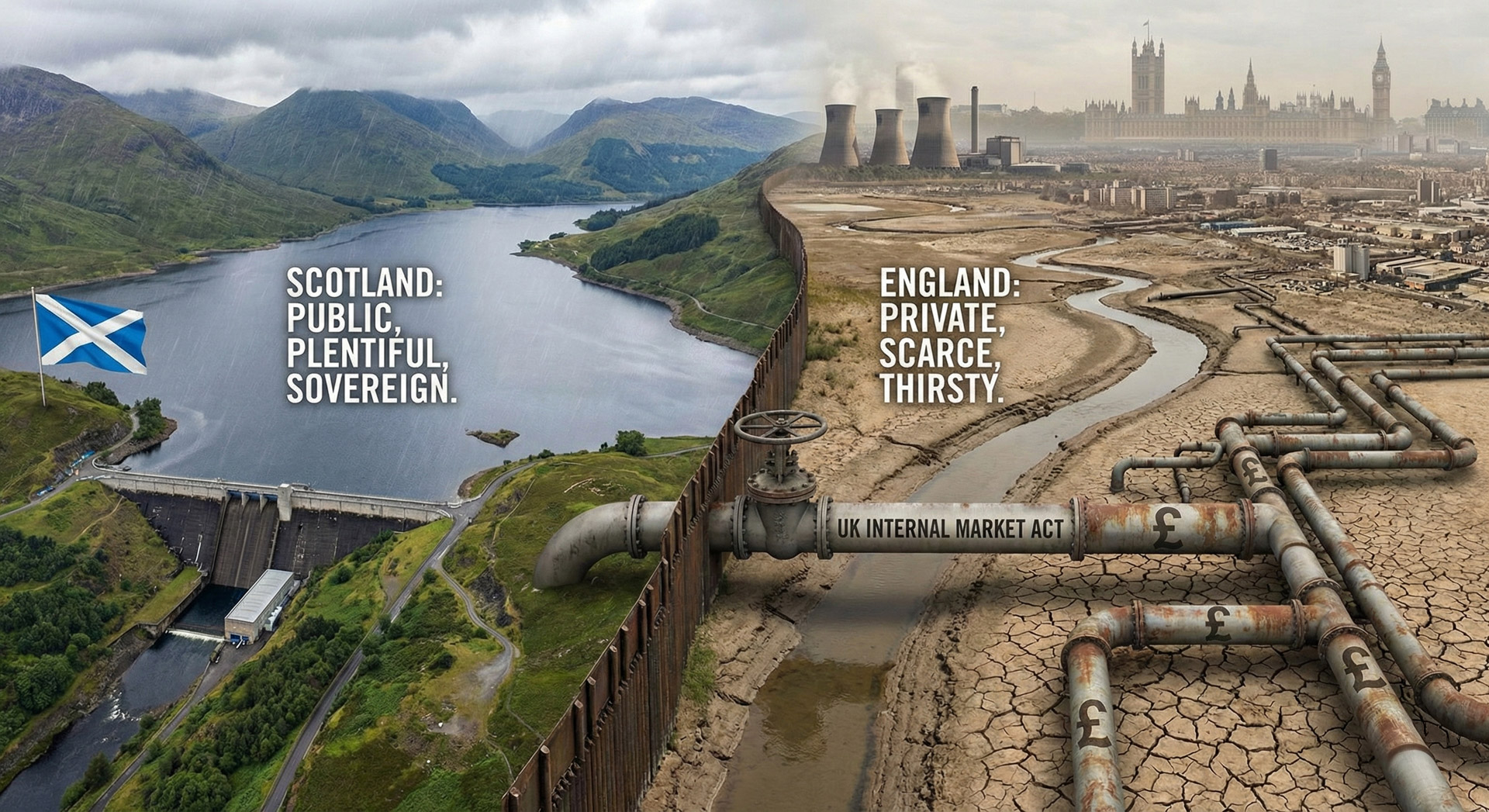
The most significant threat to Scotland’s control over its water is the UK Internal Market Act 2020 (UKIMA). This legislation was designed to ensure frictionless trade post-Brexit but significantly undermines devolution.[18]
Currently, "water" is excluded from the definition of "goods" under the Act (unless sold in limited quantities like bottles).[19] However, Section 18 of the Act gives UK Ministers the power to add, remove, or amend entries in the services exclusions schedule via secondary legislation.[20]
Crucially, while UK Ministers must "seek consent" from devolved administrations to make these changes, the Act allows them to proceed without consent after one month by simply making a statement to the UK Parliament.[21] This creates a "commodity trap." In an English water emergency, the UK government could unilaterally reclassify bulk water as a tradeable good, overriding Scottish Parliament objections to enforce transfers.[22]
7. Disadvantages to Scotland under the Union
Remaining in the Union presents distinct disadvantages for Scotland's water future:
- Fiscal Constraints: The UK government has reduced the Scottish capital block grant by 2.5% in real terms (2022-2025), directly restricting Scottish Water’s ability to borrow and invest in vital Net Zero targets and infrastructure renewal.[23]
- Resource Inequity: Scotland holds roughly 90% of the UK’s surface freshwater volume, yet funding is delivered via the population-based Barnett Formula. In a UK-wide strategy, Scotland risks providing the national resource while receiving only a fraction of the investment funding—mirroring the historical mismanagement of Scotland's oil wealth.[24]
- Commodification Risks: The push toward a "Market Framework for Natural Capital" risks opening the door to private profit extraction from natural resources, potentially making it harder to legally resist transfers under future trade rules if water is treated as a service rather than a human right.[25]
Conclusion
The evidence demonstrates that the Scottish public water model is financially superior and operationally more successful than the privatized English system. However, this success is maintained despite the Union, not because of it. The combination of England's severe projected water deficits and the centralizing powers of the UK Internal Market Act creates a profound strategic risk. Independence would allow Scotland to constitutionally enshrine public ownership, monetize any future exports on its own sovereign terms, and protect its "blue gold" from being requisitioned by Westminster.
Sources
[1] The Ferret: Fact Checking UK Environment Secretary on Water Pollution (2025)
[2] University of Greenwich: The Finance Costs of Privatised Water in England and Wales
[3] SPICe: Scotland's Water Industry Governance and Regulation (2025)
[4] Scottish Water: Annual Report and Accounts 2024/25
[5] University of Greenwich: Leaking Money - The Finance Costs of Privatised Water (Data analysis)
[6] The Herald: Scotland's Water Bills £113 Cheaper than England and Wales
[7] British Water: 2025 UK Water Company Performance Survey Results
[8] Jackie Kemp: Is Scottish Water Better Than English Water? (Ecological Data)
[9] Believe in Scotland: Scottish Water Investment in CSO Monitoring
[10] UK Parliament Library: Future Water Resources in England Briefing (2025)
[11] UK Gov: Environment Agency warning on 5 billion litre shortage by 2055
[12] Water UK: 2025-2030 Infrastructure Investment Plans (PR24)
[13] Grand Union Canal Transfer: Scheme Development and Timeline
[14] SEPA: River Basin Planning Framework for the Solway Tweed
[15] Annan History: Chapelcross Nuclear Power Station and Water Supply history
[16] The National: Tories Plot 'Great Boris Canal' for Water Transfers
[17] Scottish Government: FOI Release on Water Exporting Viability Studies (2022)
[18] Institute for Government: Analysis of The UK Internal Market Act 2020
[19] UK Government: Guidance for Traders on UKIMA Goods Definitions (Water exclusion)
[20] Legislation.gov.uk: UKIMA Section 18 - Services Exclusions and Amendment Powers
[21] Scottish Government: Analysis of UKIMA impact on Devolution and consent mechanisms
[22] SPICe Spotlight: Outcomes of the UK Internal Market Act Review (2025)
[23] Scottish Government: Infrastructure Investment Plan Progress Report (Capital grant cuts)
[24] Business for Scotland: Resource Funding inequity analogies
[25] Common Weal: Response to the Natural Capital Market Framework Consultation